
I was watching a video from a financial planner the other day. She mentioned someone in their 70s with a large IRA balance, having to take out hundreds of thousands of dollars a year because of the Required Minimum Distribution (RMD), even though his annual expenses are much lower and he doesn’t need that much money. As a result, he has to pay a high income tax bill every year the RMD is in effect, bringing his marginal bracket to one of the highest he’s seen. Scary, isn’t it? Nobody wants a big tax bill during retirement. The solution, according to the planner, is careful Roth conversion planning earlier in retirement.
Roth conversion is one of the most popular concepts and strategies in retirement planning, but it’s also one of the most misunderstood. The idea is simple: you convert part of your IRA (or 401(k) - I’ll assume all 401(k)s get rolled into an IRA at retirement, so I’ll just say IRA throughout) during the years before RMD kicks in, at a lower income tax bracket than the one you’d likely be in later, once RMDs push your bracket higher. In short, it’s a tax arbitrage strategy. You’ll see plenty of people, professional and amateur, selling Roth conversion as if it’s a must, as if skipping it means financial disaster, as if it’s one of the great retirement regrets waiting to happen.
Is that true? How big is the actual impact? Does it work for everyone? And if it does work, what’s the right amount to convert each year before RMD kicks in? These are exactly the questions that are conveniently missing from the hyped-up financial content pushing this idea.
So I built a model to find out. The concept sounds simple. The execution isn’t. I’ve tried to simplify where I could. Let’s start with the problem setup.
Objective
Before any of the math matters, you have to decide what you’re optimizing for, because different goals point to different answers.
My own goal is to maximize what’s left when I die and pass it to the next generation. That’s a personal choice - not the only reasonable goal. A close cousin of that goal is minimizing total taxes paid over your whole retirement, which usually points in a similar direction but isn’t quite the same thing, since it matters whether the tax gets paid by you or by whoever inherits your money. And if your goal is different entirely - spend it all down, leave as little as possible - Roth conversion answers a different question: not “how do I protect an inheritance” but “how do I maximize what I get to spend while I’m alive.” That’s a real alternative goal, just not the goal I am modeling here.
Everything that follows assumes the first goal: maximize the after-tax amount that eventually goes to an heir.
The key assumptions
I built this model with a stylized example - a high-net-worth married couple, filing jointly, retiring at 55 in 2026, with both spouses expected to live to 85. Here are the key modeling assumptions:
Required minimum distributions start at 75 for anyone born after 1960, which is this couple’s situation. I assumed no further conversion once RMDs begin - just the mandatory withdrawal, nothing extra. That’s the simpler, more conventional assumption; whether it’s worth continuing to convert alongside RMDs is a real question, and it’s one I will be discussing in a follow-up post. For this analysis, RMDs mark the end of the conversion window. That gives a full 20 years, from 55 to 74, to actually run a conversion strategy.
Social Security pays $96,000 a year for the couple, starting at 70 - the age that maximizes the benefit for anyone who can afford to wait. That's a realistic combined benefit for two high earners at that claiming age, well below the maximum two maxed-out earners could reach.
Living expenses run $150,000 a year, after tax. I didn’t pick that number arbitrarily. Vanguard’s research on retirement income found that households at the 95th income percentile spend roughly 44% of their pre-retirement income once they stop working. The Fed’s Survey of Consumer Finances puts the median household income for the top 10% of net worth at about $300,000 in 2022. Bring that forward to 2026 dollars (inflation ran about 14% over those four years) and you get roughly $342,000. Take 44% of that, and you land close to $150,000.
That number doesn’t stay flat. David Blanchett’s 2014 study on retirement spending found that real, inflation-adjusted spending declines by about 26% between ages 65 and 85 - roughly 1.5% a year. Early retirees tend to be more active than that later cohort, so I let the $150,000 grow with inflation, 3% a year, from 55 to 65. From 65 to 85, it grows more slowly - a net 1.5% a year, which is what you get when 3% inflation is partly offset by that 1.5% real decline.
The couple starts with $2 million in a traditional IRA and $2.3 million in a taxable brokerage account. The Survey of Consumer Finances puts median financial assets and retirement assets for the top decile of net worth at $1.94 million and $900,000 - across all ages, though, which understates what a 55-year-old in that group would actually have. The same survey shows the median 55-to-64-year-old holds about 72% more in financial assets than the typical family. Apply that adjustment, plus a modest bump for a few more years of investment growth, and you land close to $4.3 million combined - split here as $2.3 million taxable and $2 million IRA. I assumed zero starting Roth balance. Roth IRAs are mostly closed off to high earners without a backdoor conversion, and there’s no clean data on how much a typical high-income household actually holds there, so zero is a simple and convenient starting point.
Everything grows at 7% a year - the IRA, the taxable account, and the Roth account alike. This assumes a more conservative asset allocation with significant share in both equity and bond.
Tax brackets adjust for inflation every year, and I assumed 3% annually. That’s not a guess - it’s close to what’s actually happened. The 24% bracket for a married couple ran from $171,051 to $326,600 in 2020. By 2026 it ran from $211,401 to $403,550. That’s a 24% move over six years, which works out to almost exactly 3.6% a year - a bit higher than my 3% assumption, if anything.
Living expenses come out of the taxable account for as long as possible. Before 70, taxable pays for everything. Once Social Security starts, it covers part of the spending and taxable covers the rest. Once RMDs begin at 75, Social Security and the RMD are applied to spending first, since that’s cash showing up whether it’s wanted or not - and if the two of them produce more than the couple actually needs that year, the extra gets reinvested back into taxable account rather than sitting idle or spent. If they fall short, taxable account fills the gap.
The IRA itself only moves in one direction under this approach: into Roth, through conversion, or out through the mandatory RMD once required. It’s never tapped directly to cover a grocery bill. That's the conventional wisdom on withdrawal order - the default assumption behind most retirement planning advice - and it's a deliberate choice, not the only one. A more aggressive approach, drawing from the IRA before RMDs force the issue, shows up in some of the research on this, and I’m saving that comparison for a separate post.
The tax on each year’s conversion gets paid from the taxable account, not from the IRA itself. Here's why that distinction matters: say you convert $100,000 and owe $20,000 in tax. You can sell $20,000 of stock to cover it (after paying any capital gain tax) and move the full $100,000 into Roth - or you can have the $20,000 withheld directly from the conversion, in which case only $80,000 actually reaches Roth, and the withheld portion gets treated as a distribution rather than part of the conversion. Before 59½, that early distribution also triggers a 10% penalty on top of the tax you already owed. I assume the tax is paid from taxable account every time, which means conversion simply stops in any year taxable account can’t afford it.
A few more assumptions to note: selling taxable-account assets to cover spending or conversion tax triggers capital gains tax - I assumed 60% of any withdrawal represents embedded gain, taxed at a combined 25% federal-and-state rate. Eighty-five percent of Social Security is treated as taxable, the standard result once other income pushes a household past the relevant thresholds, which this one does. State tax is a flat 5% on ordinary income throughout. Two more real costs I didn't model: Medicare's IRMAA premium surcharge and the net investment income tax - including them would likely make the no-conversion case look worse, not better. I left them out to keep the model simple and focused on ordinary income tax brackets, which already drive most of the story here.
Finding the right amount to convert
The goal is to maximize what’s left at 85, valued from the heir’s perspective: taxable balance, plus Roth balance, plus whatever’s left in the IRA - discounted by whatever tax rate applies to that IRA balance specifically. In this scenario, the Roth account can ultimately be distributed tax-free. Taxable gets a full step-up in cost basis at death, which wipes out any embedded capital gains, so it passes essentially tax-free too. The IRA gets neither break. For a typical adult-child beneficiary, current rules require the account to be emptied within ten years of inheriting it - and because this owner dies well after RMDs have already started, the rules also require the heir to take annual minimum distributions in years one through nine, not just a deadline at year ten.
Rather than assume some flat tax rate for that eventual liability, I calculated it directly: simulate the ten-year forced distribution against the same inflating tax brackets, and see what blended rate that actually produces. Doing that requires an assumption about the heir's own finances, so I kept it simple: no income at all - no job, no investment income, no rental income. By 85, the heir would likely be in their mid-to-late 50s, plausibly retired, but there's no way to know a future heir's actual life decades from now. It's not fully realistic but modeling a hypothetical heir's whole financial life is a distraction from the key analysis. If they do have other income, the real tax rate on the inherited IRA runs higher than what's shown here, since it stacks on top of whatever else they're earning.
The hard part of this whole exercise is deciding how much to convert each year. Convert more, and you pay more tax now - but you also shrink the IRA that would otherwise keep growing and eventually get hit by RMDs and, later, the heir’s tax bill. Convert too little, and that future tax bill only gets bigger.
Strictly speaking, every one of the 20 years between 55 and 74 is its own independent decision, and with 7 possible tax brackets to assess each year, testing every combination means testing about 80,000 trillion possibilities, which is impractical to run. Instead, I split the conversion window into two periods - before Social Security starts at 70, and after. Social Security is the one big, permanent shift in the household's income picture during these 20 years: before 70, there's no other income competing for bracket room, so a conversion has the bracket to itself; from 70 on, $96,000 a year of taxable Social Security eats into that same room every year afterward. Splitting the window there, and assuming the household targets one consistent bracket within each period, turns an impossible search into 7 brackets times 2 periods - 49 combinations total, plus a no-conversion baseline to compare against.
Results
Compared to the best conversion strategy I could find, doing nothing costs this couple’s heir $1.36 million, or about 11% of the total bequest.
If this couple never converts a dollar, the traditional IRA compounds all the way to 85. Required minimum distributions start at 75, but they’re initially small relative to the account, so the IRA keeps growing even after they start. By 85, it reaches $9.23 million. The taxable account, which funds the couple’s living expenses along the way, ends at $5.08 million. Roth stays at zero.
Add those balances together and the total looks enormous - more than $14 million. But that isn’t what the heir actually gets. Once the IRA’s 10-year forced distribution and the resulting tax bill are worked in, that $9.23 million is really worth $6.99 million to the heir.
The no-conversion strategy leaves the heir with $12.07 million after tax. That’s the number a conversion strategy has to beat.
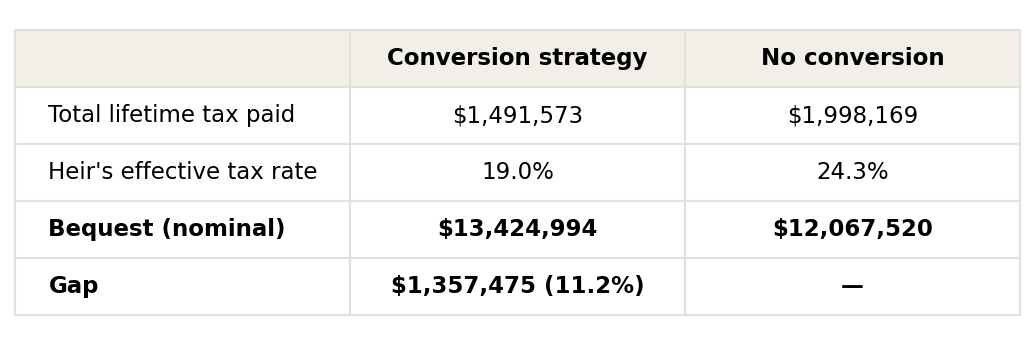
Among the 49 combinations I tested, the best one targets the 12% bracket before Social Security and no conversion after Social Security starts. Results from this best conversion strategy is compared with those from the no-conversion scenario in the table shown above.
From 55 through 60, the best combination fills the entire 12% bracket. The dollar amount rises from $133,000 at 55 to $154,000 at 60 because the tax brackets and standard deduction both inflate at 3% a year. In real terms, the target barely moves.
Starting at 61, the household can no longer afford to fill the bracket.
At 61, filling the 12% bracket would take a $158,809 conversion. The model allows only $96,162. At 62, the bracket would need $163,573; the model converts just $39,602 - barely more than the standard deduction, so almost none of it is even taxed.
From 62 through 69, conversions stay pinned near that tax-free floor.
The issue isn’t the tax rate. It’s funding constraint of the taxable account. The taxable account has to fund both the couple’s living expenses and the taxes on every year’s conversion. Starting at 61, it simply can’t fund a full bracket fill without putting the rest of the retirement at risk.
At 70, Social Security begins, and conversion stops entirely - not because there's no reason to keep going, but because converting any further would drain the taxable account before RMDs arrive at 75. Nine years of funding both living expenses and conversion taxes has almost depleted the taxable account.
The strategy pays $1.49 million of tax along the way, concentrated in the early years, but leaves a much smaller tax bill for the heir. Doing nothing pays $2 million in lifetime taxes, most of it later as growing RMDs get taxed - and that’s before the heir’s own tax bill on whatever’s left in the IRA.
The result: $13.42 million passes to the heir after tax under the conversion strategy, versus $12.07 million with no conversion - $1.36 million more.
The chart below tracks all three accounts, year by year, under both scenarios - red for no conversion, blue for the best conversion strategy, with a different line style for each account.
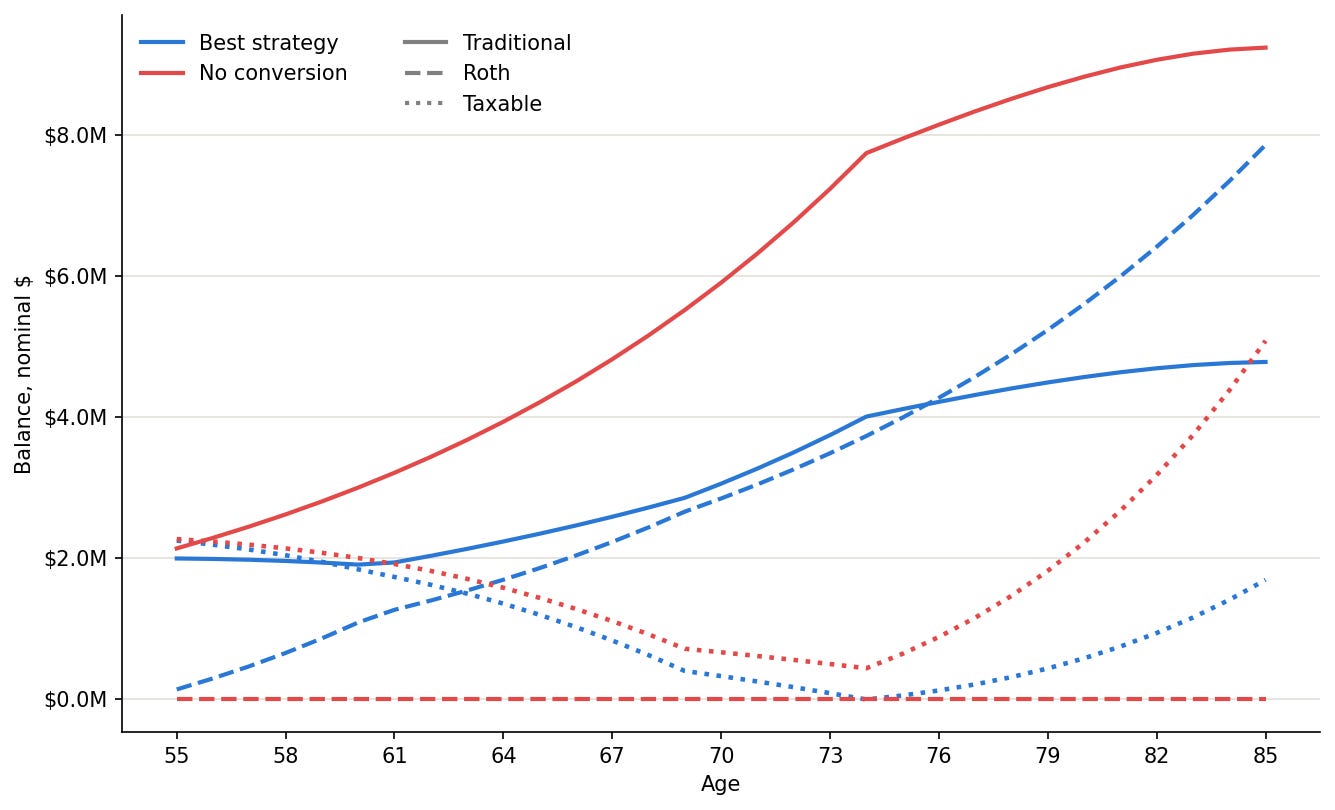
The shapes tell the story on their own. The red solid line - traditional IRA, no conversion - climbs alone and ends up the single largest balance of either scenario, at $9.23 million, while red’s dashed Roth line never leaves zero. In the best conversion strategy, that’s reversed: the blue dashed Roth line does the climbing instead, overtaking blue’s own traditional IRA solid line around 75 and finishing as the largest balance under the conversion strategy, at $7.86 million, while traditional IRA ends at a comparatively modest $4.78 million. The dotted blue taxable account lines dips to zero right at 74, the last dollar spent just before RMDs begin at 75, then climbs back as Social Security and RMDs start bringing in more than the couple needs to spend, where the excess is then reinvested in the taxable account.
How sensitive are the results to assumptions?
I tested two assumptions that could plausibly move the results: how much the couple spends, and how fast the money grows.
Lower spending: more taxable account liquidity means more room to convert
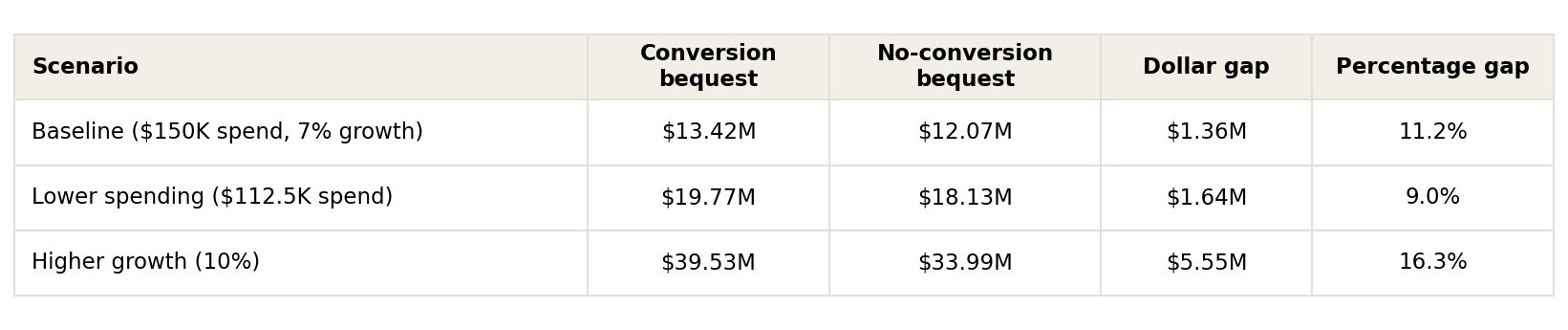
First, I cut spending by 25%, from $150,000 to $112,500 a year.
The effect on the strategy itself is straightforward. With less pulled from taxable account to cover living expenses, there’s more room left to pay the tax on conversions. The model can now fill the 12% bracket every single year through 69, instead of running out of room at 61.
The dollar advantage rises from $1.36 million to $1.64 million.
The percentage advantage actually falls, from 11.2% to 9.0% - but I wouldn't read much into that. Lower spending makes the no-conversion baseline itself much bigger - it grows by about 50%, from $12.07 million to $18.13 million, since less gets spent and more compounds either way. The conversion advantage grows too, but by only about 21%, from $1.36 million to $1.64 million. The number being divided into grew faster than the number on top, so the percentage shrinks even though the dollar figure gets bigger.
The result worth remembering isn’t the percentage. It’s that more taxable liquidity lets the household actually finish the plan — filling the full 12% bracket every year, instead of running out of room at 61.
Higher growth: the biggest payoff from conversion
Raise the growth assumption from 7% - a reasonable long-run rate for a portfolio holding a mix of stocks and bonds - to 10%, closer to what an all-equity portfolio has historically performed. The dollar advantage jumps from $1.36 million to $5.55 million. The percentage advantage rises from 11.2% to 16.3%.
Here’s why. A dollar converted early compounds tax-free in Roth for the rest of the couple’s life. A dollar left in Traditional compounds too, but every dollar of that growth eventually gets taxed when the heir inherits it. The faster the money grows, the more it costs to have left it in the account where growth gets taxed.
The numbers show this directly. Under no conversion, the Traditional IRA reaches $21.76 million by 85, and the heir’s effective tax rate rises from 24.3% to 34.7% - a bigger balance pushes further into higher brackets. Under the conversion strategy, Traditional reaches only $6.58 million, while the Roth compounds completely tax-free.
Key takeaways
Roth conversion, done right, increases what an heir eventually gets - mostly by moving money out of the one account that's guaranteed to be taxed, and into two that aren't. What's left in the IRA also ends up taxed at a lower rate, since a smaller balance lands in lower brackets during the heir's forced ten-year payout, but that's the smaller half of the story. In this example, the combination is worth $1.36 million.
The impact is larger the faster the money grows - whether that’s from a more aggressive asset allocation, like 100% equities instead of a stock-and-bond mix, or from a long stretch of good returns. Raise the growth assumption from 7% to 10%, and the benefit jumps from $1.36 million to $5.55 million.
Size of taxable account decides how much of conversion you can actually do. Converting to Roth only works cleanly if you can pay the resulting tax bill from outside the IRA — otherwise you’re funding it with IRA money itself, which shrinks the conversion and can trigger a penalty before 59½. If taxable account balance runs short, conversion gets capped by what’s actually available in taxable account, not by how much you’d like to convert.
The size of the conversion benefit varies a lot by different conditions, from 9% in one test here to over 16% in another. That’s reason enough to run your own situation rather than copy a strategy that worked for someone else’s.
Even for the same household, there’s a specific combination that gets the most out of the conversion - which bracket to fill, and for how long. Picking an arbitrary bracket, or converting for the wrong number of years, gets you a smaller number - sometimes a lot smaller. Finding the actual winning combination is the real work here, not just deciding to convert.
I am not a financial advisor. Nothing in this post is investment or tax advice. The numbers here come from a model built on stated assumptions, not a recommendation for your specific situation - please consult your CPA or tax advisor before making any Roth conversion decisions. If this made you want to run your own numbers - good, that’s exactly the point. Hit reply and tell me what you found.